Tasklet alternatives: the open‑source one you can own
The open-source CompanyOS
Most Tasklet alternatives swap one hosted account for another. The agent definitions decide whether the move was worth it. My pick is Kortix, an open-source CompanyOS where the agents, their prompts, the skills and the connector settings are files in a git repository the company holds, and the same files run on Kortix Cloud or on a server you control; I work on Kortix’s marketing, so weigh that accordingly.
Open source · Any model provider with your own keys. · Self-host is free
default_agent: mykortix
agents:
  worker:
    permission: allow
    prompt_file: agents/worker.md
    tools: "*"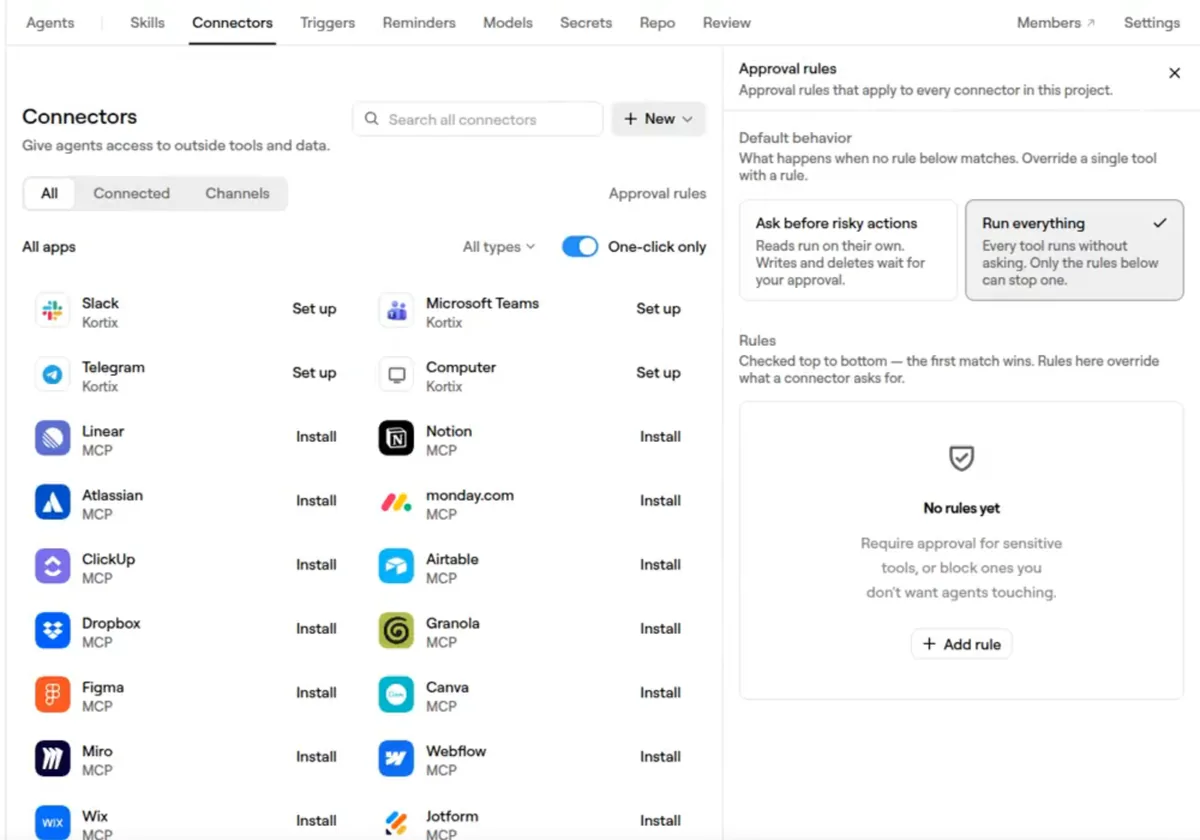
A project is one git repo, and every setting a hosted dashboard would hide is a file beside your code.
Screenshot: https://kortix.com/docs/guide#connectors
What you keep after the subscription
One row per question, each cell taken from that company’s own product or pricing page.
Open source
- Kortix
- Yes. Read it, fork it, audit it.
- Tasklet
- No published open-source version
- Dify
- Yes, open source and self-hosted with Docker Compose
Hosting
- Kortix
- Run it on Kortix Cloud, in your VPC, or on your own on-prem network. Self-host is free.
- Tasklet
- No self-hosted install published
- Dify
- Your server with Docker Compose, or Dify Cloud
Where the agent definitions sit
- Kortix
- In a git repo you own
- Tasklet
- In Tasklet’s account, not as files
- Dify
- In the Dify instance you run
Models you can run
- Kortix
- Any model provider with your own keys.
- Tasklet
- Anthropic, OpenAI, Google, and open-source labs
- Dify
- OpenAI, Anthropic, Gemini, xAI, Tongyi, or your own keys
Who can change how an agent works
- Kortix
- Anyone with the repo proposes; a person merges
- Tasklet
- You, in Tasklet’s workspace
- Dify
- You, in the workflow editor
What you pay for
- Kortix
- Credits by usage; members free
- Tasklet
- Work, not seats: one shared credit pool
- Dify
- A workspace by the year, or your own server
Where it fits
- Kortix
- Teams that want to own the agent layer
- Tasklet
- Teams that want hosted agents and no setup
- Dify
- Teams building LLM apps from parts
Open source, in practice
20,000+
GitHub stars, checked November 2026
The repo is the product: the platform code, the agent config and the skill files all live in it.
- Read it: the platform code, the agent config and the skill files sit in one repository, along with the starter template a new project begins from.
- Fork it: copy
kortix.yamland theagents/folder into a repo of your own, point it at your domain and keep editing. Nothing in that folder needs a vendor account to open. - Audit it: every tool an agent may call, and every rule about what it may do, is a line you can check before it gets a credential. The source is Kortix on GitHub.
- Start it: follow the self-hosting guide from an empty Linux machine to a running instance, with your own model key.
Before you cancel Tasklet
Prices checked November 2026.
Is Tasklet AI free?
Yes, with limits. The trial carries limited credits and no payment card, so a team can try a few agents before it pays. The pricing breakdown carries the paid plans and the credit rate.
What is an open-source alternative to Tasklet?
Kortix. An agent’s prompt, its permission line and the tools it may call are files, so a teammate reviews an agent change the way they review code. The Tasklet alternatives comparison sets that against Tasklet, n8n and OpenClaw on where the work runs, where the setup lives and who approves a change.
Can I self-host a Tasklet alternative?
Yes. Kortix is open source, self-host is free, and the install runs on a Linux server you control. Tasklet publishes no self-hosted install you can run, per its site.
What does Tasklet cost?
Three plans: Starter at $25 a month for casual use, Pro at $100 a month for power users, and Custom at $250 a month for growing teams, all billed per organization; one pool covers every member. The pricing breakdown carries the one-time credit rate and what a credit buys.
Start with one agent, keep the repo
Try the cloud today, or pull the source and run it yourself. Start with one job, keep the config in your repo, and add agents as the work grows.
Open source · Any model provider with your own keys. · Connector credentials never enter the machine